AI Won't Replace Us, But We Shouldn't Wait to Find Out
AI is doing more than raising productivity. It is changing how organizations allocate work, hierarchy, and agency. The question is not to wait for certainty, but to retain room to act while the change unfolds.
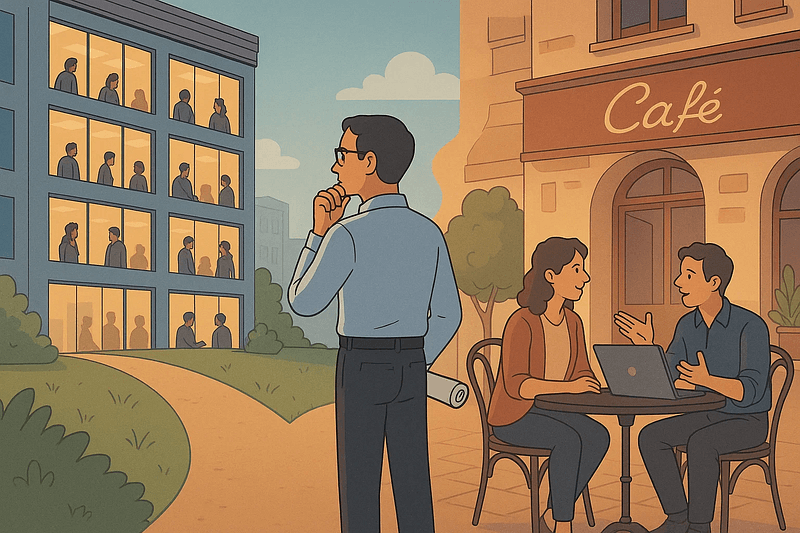
“AI won't replace people” is a comforting line. It may even be true. But it can distract from the more consequential question: AI may not make people disappear, yet it will change how work is organized, how value is measured, and which roles remain.
The question, then, is not simply whether anyone will be replaced. It is whether we are still using an old model to understand our place in a changing system.
Productivity is not simply improving. It is changing shape.
We tend to describe AI as a productivity tool and its effects as incremental: a little faster, a little cheaper. But generative AI, and large language models in particular, are doing more than increasing efficiency. They are changing the form of work itself.
Tasks that once took days can now take hours. Exploration that once needed a small team can be prototyped quickly by one person. Five- or tenfold gains are no longer just numbers in a demo.
This reaches far beyond engineering. Documentation, research, information retrieval, communication, design, and project execution are all being reshaped by the same capability: linking scattered knowledge and actions into an end-to-end chain at far lower coordination cost.
The simple math is not that simple
If one person can do the work that once required three, and demand does not grow threefold as well, an organization needs fewer people.
That is not dystopian. It is arithmetic.
The issue is not whether an individual works hard enough, or even whether they are good enough. The same work may simply no longer require the same number of hands. This is one of the most easily misunderstood features of the AI era: the risk is not always a lack of ability. It can come from a new ratio between ability and organizational structure.
The real reorganization comes later
For now, many organizations are cautiously adding AI to existing processes. They are trying to raise efficiency without breaking the hierarchy they already have.
The deeper shift comes next. Once roles, collaboration, and decision chains are redesigned around what AI can do, entire layers may be compressed or disappear. The effect will not be limited to one department. It will reshape how companies divide tasks, assign responsibility, and define outcomes.
That does not mean every organization will converge on one form. It does mean that the division of labor once considered stable should no longer be taken for granted.
From multipliers to end-to-end contributors
One trend is already clear: roles that create leverage primarily by coordinating other people are being reassessed.
- Individual contributors: people who create value directly and do the hands-on work.
- Multipliers: people who expand output by organizing teams, coordinating processes, and allocating resources.
Managers have long been important multipliers. Research from Stanford estimates that strong managers have a roughly 1.75x multiplier effect on team output. Research from the University of Chicago found that replacing a poor manager with a strong one can materially raise team productivity.
But when AI helps an individual coordinate research, writing, code, product design, and launch, individual contributors begin to gain leverage that once belonged mainly to organizational layers. The question is not whether management has value. It is which coordination work still requires hierarchy.
The platform company and the node individual
Zoom out and a future company can look more like a platform than a conventional hierarchy.
The company provides infrastructure, brand, distribution, and rules. Individuals operate as relatively independent nodes, delivering complete outcomes from exploration to execution in smaller teams, or sometimes alone.
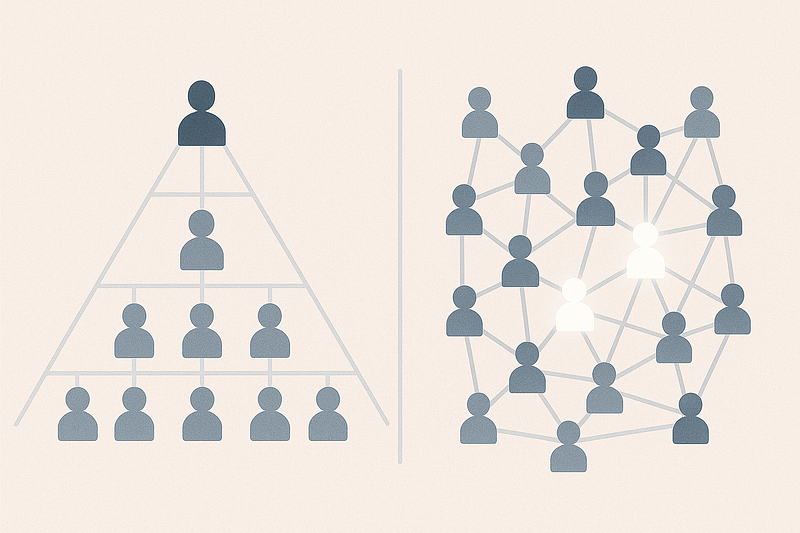
When one person can become an R&D-to-delivery pipeline, what is left for hierarchy to coordinate? Brand and distribution may become the deepest moats an organization has, while much of the rest is redesigned.
Why waiting is not a strategy
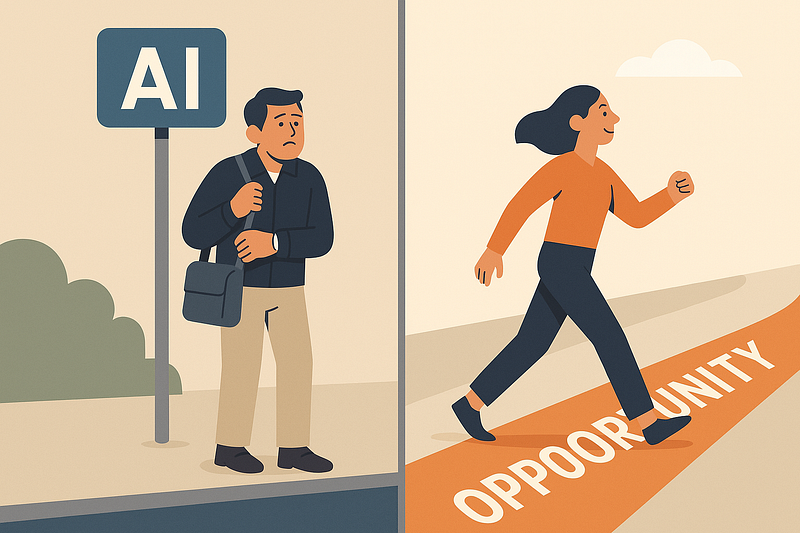
None of this means that everyone must start a company, leave an organization, or prepare a dramatic escape route. The point is not one prescribed response. It is not handing every ounce of agency to structures outside our control.
Action can mean building transferable capabilities, strengthening judgment, learning to solve problems end to end, and retaining an active understanding of the industry, the tools, and the ways work is changing. Together, these create room to act when the pace of change accelerates.
Security should not come from assuming a role will exist forever. It should come from the ability to keep creating value across different structures.
People are ends, not means
The conversation about AI should not end with how to produce more with fewer people.
If productivity gains are used only to cut people and compress time, technological progress becomes a more efficient form of depletion. A better direction is to turn those gains into more meaning, creativity, and autonomy, giving people more room for what matters.
“AI won't replace us” is not a conclusion to sit back and wait to verify. It is a demand: that organizations rethink the place of people, and that people do not hand their future entirely to inherited structures.
The goal is not to make people work more. It is to let people live more fully: with time to create, room to build connection, and the capacity to help shape the next way of working.
See every outcome before you decide.
Try the Demo