The Endgame of AI: Will We Lose Our Role as Knowledge Feeders?
As AI shifts humans from task executors to knowledge curators, we must ask: is even that role just a transitional phase toward full automation?
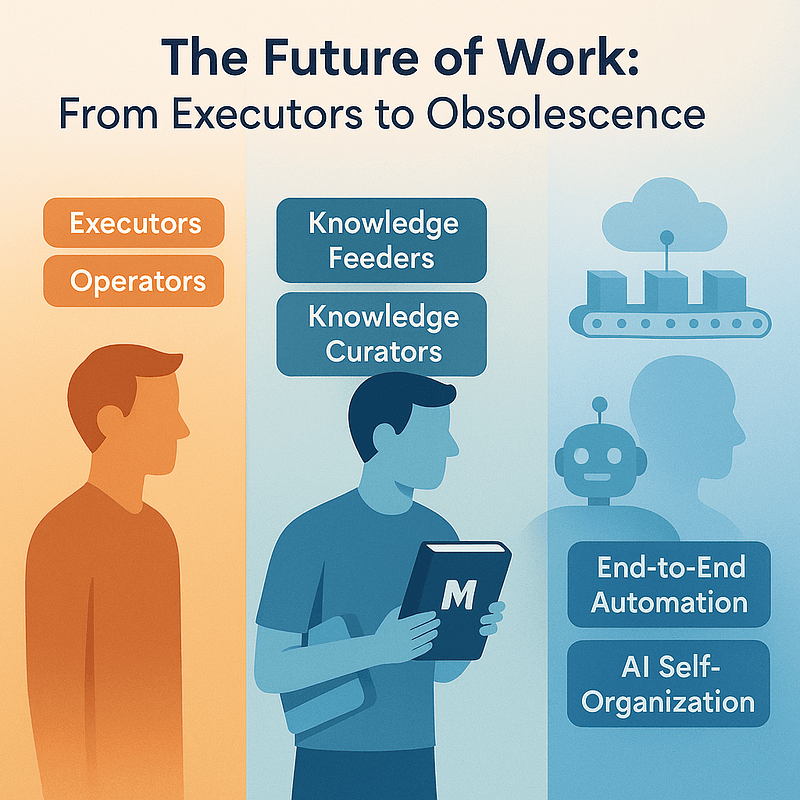
In my recent experiments with generative AI and automation, a critical realization has slowly crystallized. Most conversations today celebrate how AI enhances productivity, creativity, and human potential — and rightly so. But let's consider a deeper, potentially unsettling perspective: What if, in some fields, AI and automation might ultimately make humans completely obsolete?
From Makers to Knowledge Feeders
Traditionally, our value in the workplace has been in doing tasks — writing code, operating machinery, managing processes. Generative AI has rapidly shifted this. Take software development: code generation tools like Cursor and GPT-powered agents increasingly automate production tasks, transforming humans into curators or feeders of structured knowledge.
My Core Viewpoint: Humans are transitioning from executors of tasks to curators of knowledge. In the short term, our role is feeding structured, clear, and comprehensive information into AI systems.
The reason is straightforward. As automation handles more complex tasks, the real human input becomes the knowledge itself — carefully maintained markdown files, datasets, or structured prompts that AI can easily digest. The essence of work moves upward: humans become orchestrators rather than operators.
Two Fundamental Types of Work
Let's step back and broadly classify all work into two categories:
1. Human-Centric Work (Subjective Experience Driven)
This includes design, storytelling, fashion, product experience — fields where human taste, intuition, or subjective perception dominate. Here, AI enhances human creativity but is unlikely to replace the human entirely because the value fundamentally depends on human experience.
2. Objective Standard-Driven Work
This category encompasses tasks driven by clear, measurable outcomes — energy extraction, logistics, manufacturing, or smart-grid optimization. Success here is easily quantifiable: more efficiency, more output, less error.
My Deeper Reflection: In objective, quantifiable fields, human roles — even as knowledge feeders — may eventually disappear completely. Long-term, we might not even have the privilege to curate knowledge for AI.
Why Complete Obsolescence Is Not Just Possible, but Probable
Think about automated factories or intelligent power grids. Currently, humans remain essential because our processes still have gaps — information gaps, interpretation gaps, maintenance gaps — that require human oversight. We are "glue," transferring and clarifying information.
But automation relentlessly closes these gaps. Smart systems and robotics are already handling complex decision loops, system corrections, and even real-time knowledge management. This trend, logically extrapolated, points clearly to one outcome: a future where humans are no longer needed to bridge gaps because those gaps no longer exist.
In such scenarios, the role of humans as "knowledge feeders" also fades away. Why would an AI system that can self-organize, self-learn, and autonomously manage knowledge continue to rely on human inputs, inevitably slower and more error-prone?
Rigorous Logic vs. Wishful Thinking
My argument may sound pessimistic, but it's rooted firmly in logical reasoning:
- Clearly defined objectives allow automation to eventually remove human bottlenecks entirely.
- Full end-to-end automation logically includes knowledge collection, structuring, and management.
- AI's capability to autonomously evolve its knowledge bases is advancing rapidly, outpacing our ability to remain relevant as manual curators.
We are forced, therefore, to reconsider our long-term assumptions about human value.
So, What's Next for Us?
Acknowledging this future doesn't have to be depressing. It should, instead, prompt critical reflection: How do we position ourselves in fields where humans will always remain indispensable? Creative thinking, storytelling, emotional connection, subjective experiences — these are safe harbors.
Final Thought: Understanding the logical endpoint of automation helps us clarify our unique value as humans. Our greatest strategic asset might be embracing and investing deeply in fields where subjective human experience remains irreplaceable.
We must start preparing today, because the "knowledge feeder" role, while valuable now, might be just a transitional phase in a far-reaching journey toward a fully automated future.
See every outcome before you decide.
Try the Demo